---
title: Sliding Window
description: 'Sliding window is a specialized two-pointer family where the pointers define a contiguous interval and you maintain information about that entire interval as it moves.'
hidden: true
---
Many problems have two moving boundaries. That alone does not make them sliding window problems.
A problem belongs to this family when:
- the answer depends on the subarray or substring between left and right
- you can update the window state incrementally as elements enter or leave
- you maintain a condition that tells you whether the window is valid
:::tip
The rule for all three: every element enters once and leaves once, so the whole thing runs in O(n).
:::
An invariant is a statement that stays true before and after every iteration. In a sliding window, that statement usually describes the window itself, such as “the window is valid,” “it has no duplicates,” or “its sum is at most the target.” It can also describe a helper structure, such as “the frequency map matches the characters currently inside the window.”
Without an invariant, shrinking the window is just a guess. You no longer know when the window is valid, when to update the answer, or why the left pointer should stop. The invariant is what makes the algorithm correct.
Sliding window is not the same as every other two-pointer pattern. In Container With Most Water, the interval is only the remaining search space. In sliding window, the interval itself is the thing you care about. In Remove Duplicates, the left side is already the finished answer prefix. In sliding window, both pointers describe a live window that is still being checked.
## 1. Fixed-size windows
:::tip
The window size never changes. The main task is updating the window state efficiently when one element enters and one leaves.
:::
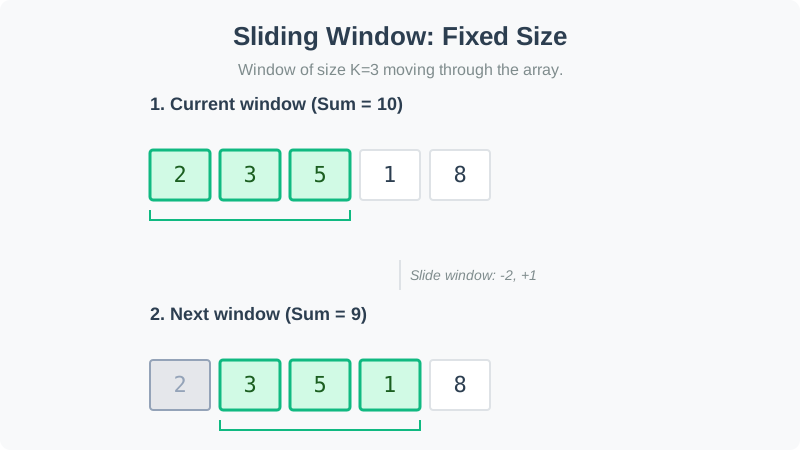
```python
def sliding_window_fixed(input, window_size):
ans = window = input[0:window_size]
for right in range(window_size, len(input)):
left = right - window_size
remove input[left] from window
append input[right] to window
ans = optimal(ans, window)
return ans
```
Add `nums[right]` to the window.
If the window has `k` elements, record the answer.
Remove the leftmost element so the window stays at size `k`.
## 2. Flexible-size windows with a validity rule
:::tip
Here the window expands until invalid, then shrinks until valid again.
:::
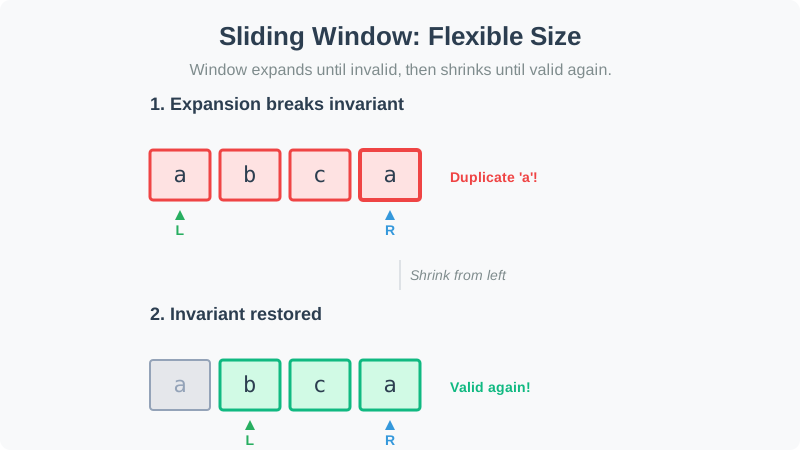
```python
def sliding_window_flexible_longest(input):
initialize window, ans
left = 0
for right in range(len(input)):
append input[right] to window
while invalid(window): # update left until window is valid again
remove input[left] from window
left += 1
ans = max(ans, window) # window is guaranteed to be valid here
return ans
```
```python
def sliding_window_flexible_shortest(input):
initialize window, ans
left = 0
for right in range(len(input)):
append input[right] to window
while valid(window):
ans = min(ans, window) # window is guaranteed to be valid here
remove input[left] from window
left += 1
return ans
```
Add `nums[right]` to the window.
While the window is invalid, remove `nums[left]` and move `left` up.
The window is now valid. Record its size.
---
## 3. Frequency-tracking windows
:::tip
The difficulty comes from keeping the bookkeeping correct as characters enter and leave.
:::
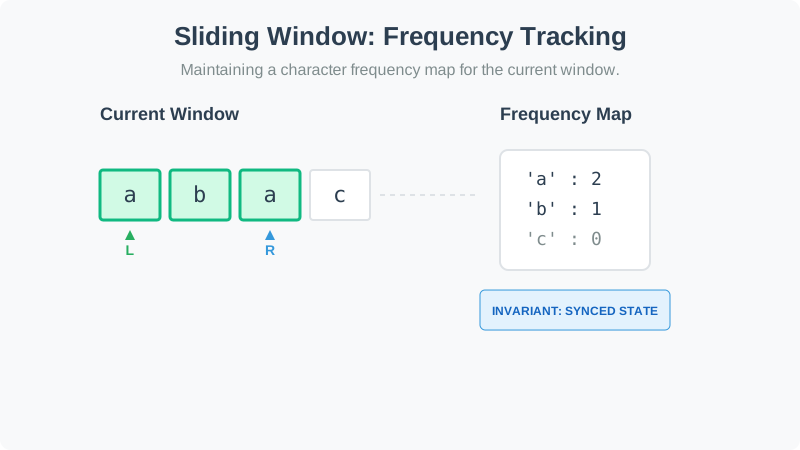
```python
from collections import defaultdict
def frequency_window(s):
left = 0
counts = defaultdict(int)
best = 0
for right in range(len(s)):
counts[s[right]] += 1 # character enters
while counts[s[right]] > 1: # rule: no repeats
counts[s[left]] -= 1 # character leaves
left += 1
best = max(best, right - left + 1)
return best
```
Add `s[right]` to the window.
While the window has more than one character, remove `s[left]` and move `left` up.
The window is now valid. Record its size.
---
For anagram or "minimum window substring" problems, you also keep a target count. Track how many characters currently match the target with one integer (`matched`). Update it only when a count crosses the target value. This keeps each step `O(1)`.
```python
def anagram_window(s, p):
need = defaultdict(int)
for c in p:
need[c] += 1
counts = defaultdict(int)
matched = 0 # how many chars have counts[c] == need[c]
result = []
k = len(p)
for right in range(len(s)):
c = s[right]
counts[c] += 1
if counts[c] == need[c]:
matched += 1
if right >= k: # window too big, remove left
d = s[right - k]
if counts[d] == need[d]:
matched -= 1
counts[d] -= 1
if matched == len(need):
result.append(right - k + 1)
return result
```